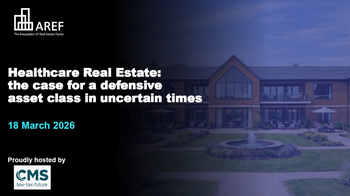
Healthcare Real Estate: the case for a defensive asset class in uncertain times
18th March 2026
This seminar hosted by CMS discussed investing in this specialist area of the living sector. An introductory presentation by Ryan Richards from Knight Frank was followed by a panel discussion.
You can find Ryan’s presentation here

For the panel, Ryan was joined by:
- John Forbes, John Forbes Consulting LLP (moderator)
- Andrea Auteri, Managing Partner, Elevation Advisors LLP
- Michael Toft, Senior Fund Manager of Octopus Healthcare Fund
- Rebecca Middleton, Director, DTZ Investors
The panel started off by picking up some of the key points from Ryan’s presentation. Despite the huge geopolitical uncertainty and immediate economic challenges, the fundamentals driving the business case for investment in healthcare assets remains unchanged. The underlying supply / demand imbalance and the needs-based nature of the services underpins the investment proposition. In the long term, private capital will continue to be needed to improve the social infrastructure in the UK and the benefits that can have for the secondary and primary healthcare system will provide long term performance in the sector.
Both the presentation and the panel discussion concentrated a key subset of the broader healthcare opportunity, housing with care for the elderly. In terms of the supply / demand imbalance, the UK is losing ground. Demand is rising and the supply of beds is shrinking. On the demand side, the population is living longer with higher acuity conditions. On the supply side, more properties are being taken out of the market due to obsolescence than are being built. This cannot be rectified instantly. The UK has some inherent challenges with the planning system that make it difficult to turn on supply. The new properties are generally better and larger. Much of the older stock lacks basic amenities such as en-suite bathrooms. Also a lot of the smaller homes are being taken out of permission and the new ones that are registered are at a larger size of between 60 to 100 beds. An audience member pointed out that this is still low relative to elsewhere in Europe where up to 150 bed properties are available. This may also come in this country in due course. This is easier where funding from the state is available.
Although there are many ways of investing in this sector, much of the discussion concentrated on a model relevant to all of the panellists – properties let on very long-term triple net FRI leases to an operator with an annual inflation adjustment. This is a very attractive proposition for pension investors. Globally healthcare is becoming recognised as an investment class in its own right. With this lease model, the quality of the operators is key.
This led to a discussion of operational risk, reputational risk and due diligence. Investors do not want to be associated with negative headlines, and the sector has been historically prone to these. There was unanimous agreement on the panel that deep operational experience is necessary in this sector – it is a space for experts rather than those allocating more broadly. This was equally applicable whether an equity investor or a lender. Clinical governance at the operator level is fundamental. It also key that the terms of the lease allow intervention if a problem is identified.
The regulator also has an important role. In the UK, the Care Quality Commission monitors not only the care quality, but also since 2015, has been monitoring the financial resilience of systemically material operators, because a lot of the mistakes in the past.
There was general recognition that, as with other living assets, affordability is an issue. Other continental markets have decided that the government should pay for care whereas the UK has not. Affordability is likely to become an even bigger issue going forward unless there is significant structural change. Future generations retiring are unlikely to be as asset rich as the current generation. There is an open question as to whether there might be social impact investors moving away from a pure traditional profit driven metric for deciding to invest. This is a question of degree – even under the current model, investment in housing with care for the elderly has a demonstrable, positive social impact, albeit there is a significant challenge in quantifying it.
Audience questions prompted a discussion on new technology and artificial intelligence that covered technology to monitor the conditions of the resident within the room that can reduce the need to go to physically check, data management to improve decision making at the building and portfolio level and waste tracking.
The final conclusion from the panel was that there is still a significant and enduring opportunity for private capital to galvanise our social infrastructure and meet this significant societal need.
The enthusiastic audience continued the discussions in the networking that followed the seminar and there was considerable interest in a follow-up event.
Event resources
Presentation Slides
Download the slides by clicking here, or on the image below:
Kindly hosted by CMS

Author